
Short answer
Epley and Brzycki both predict your one rep max (1RM) from a lighter set. Lifting 155 lb for 8 reps gives about 196 lb with Epley and 192 lb with Brzycki. They agree closely at around 10 reps and drift apart as reps rise, so averaging several formulas is the safest estimate.
The One Rep Max Calculator runs seven formulas at once and shows the average, so you do not need to pick one.
1. Epley vs Brzycki at 100 kg
| Reps | Epley | Brzycki |
|---|---|---|
| 3 | 110.0 kg | 105.9 kg |
| 5 | 116.7 kg | 112.5 kg |
| 8 | 126.7 kg | 124.1 kg |
| 10 | 133.3 kg | 133.3 kg |
| 12 | 140.0 kg | 144.0 kg |
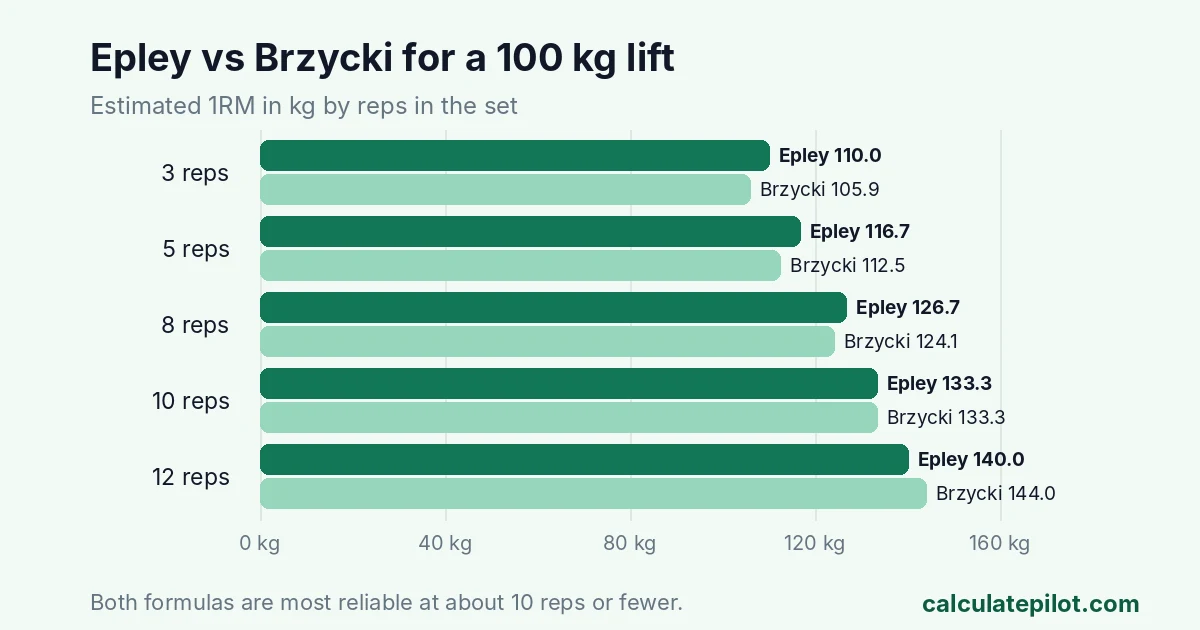
Epley gives a higher number at low reps and a lower one at high reps. Both are most reliable for sets of about 10 reps or fewer, and accuracy falls as reps increase (LeSuer et al., 1997).
2. Worked example: 155 lb for 8 reps
- Epley: 155 × (1 + 8 ÷ 30) = 196 lb.
- Brzycki: 155 × 36 ÷ 29 = 192 lb.
- O'Conner: 155 × 1.2 = 186 lb.
- Across seven formulas the range is about 186 to 198 lb, averaging about 193 lb. An 85% load would then be about 164 lb.
3. Using your 1RM for training
The NSCA's general guidance:
- Strength: about 85% of 1RM or more for 6 reps or fewer.
- Muscle size (hypertrophy): about 67–85% for 6–12 reps.
- Muscular endurance: 67% or less for 12 or more reps.
Re-estimate every 4–8 weeks as you get stronger. Fuel the work with enough protein: see how much protein you need per day and the Protein Calculator.
4. Safety
Testing a true 1RM carries more injury risk than a submaximal set. Use good form, a spotter or safety bars, and do not test through pain. Predicting from a set of 3 to 8 reps is safer and nearly as useful.
5. Quick habits for busy lifters
- Log every working set so you can re-estimate your 1RM without testing.
- Warm up with two or three lighter sets before your top set.
- Track lean mass with the Lean Body Mass Calculator and fuel with your TDEE.
6. Frequently asked questions
What is the best formula for one rep max?expand_more
No single formula is best. Epley and Brzycki are the most used, and both are most accurate for sets of about 10 reps or fewer. Averaging several formulas, as the calculator does, smooths out their quirks.
What is the Epley formula?expand_more
Estimated 1RM = weight x (1 + reps / 30). Lifting 155 lb for 8 reps gives about 196 lb.
What is the Brzycki formula?expand_more
Estimated 1RM = weight x 36 / (37 - reps). Lifting 155 lb for 8 reps gives about 192 lb.
Is it safe to test a true one rep max?expand_more
A true max carries more injury risk than a submaximal set. Use good form, a spotter or safety bars, and do not test through pain.
How often should I re-estimate my 1RM?expand_more
Every 4 to 8 weeks as you get stronger, so training weights do not become too light.
7. Sources
- menu_bookLeSuer DA, McCormick JH, Mayhew JL, et al. The accuracy of prediction equations for estimating 1-RM performance in the bench press, squat, and deadlift. J Strength Cond Res 1997;11:211–213.
- menu_bookBrzycki M. Strength testing: predicting a one-rep max from reps-to-fatigue. J Phys Educ Recreat Dance 1993;64:88–90.
- menu_bookEpley B. Poundage chart. Boyd Epley Workout. Lincoln, NE, 1985.
- menu_bookHaff GG, Triplett NT (eds). Essentials of Strength Training and Conditioning, 4th ed. National Strength and Conditioning Association. Human Kinetics, 2016.
This is general information, not medical advice. Check with a healthcare professional before changing your diet, exercise or fluid intake.